

Orlando City has been looking for its next superstar Designated Player (DP) since Luis Nani graced the pitch in Orlando. Unfortunately, Nani left in 2021 and since then, the team has struggled to find that new face of the club. Mauricio Pereyra, Facundo Torres, and Martín Ojeda have all been great stewards for the club but never had that level of prestige and class that Kaka or even Nani, had. In comes Antoine Griezmann, a French star who has been featured on the world stage for over a decade. So for those that don’t know, let’s answer the questions: who’s Antoine Griezmann and what does he bring?
Transfer Rumor
Antoine Griezmann has been linked to MLS for the past few years, with the latest team being LAFC. However, on February 23rd, Tom Bogert from The Athletic reported that Orlando City was talking to Griezmann, not any of the other teams he’s been linked to in the past.
💣🇫🇷🟣 BREAKING: Orlando City is in talks to sign Antoine Griezmann from Atletico Madrid, sources tell @PaulTenorio, @MarioCortegana and me.
Orlando has an open DP spot. Griezmann a top option they are chasing. https://t.co/65dZaF63Tb
— Tom Bogert (@tombogert) February 23, 2026
In the report, Tom Bogert, Paul Tenorio and Mario Cortegana explained that Orlando City general manager and sporting director Ricardo Moreira traveled to Spain multiple times to work on a deal. Four MLS teams expressed interest in signing Griezmann but Orlando City held his MLS discovery rights.
The original goal for the club was to sign Griezmann before the winter window closed on March 26th but there was a lot of back and forth between the player and his former club, Atletico Madrid. It became very clear that the player wasn’t interested in leaving until the end of their season, which wraps up in the summer before the World Cup. Atletico Madrid made it difficult for the player since they progressed to the Copa del Rey final and advanced in the Champions League. With all that pressure, the deal to come in the winter window was dead. Fabrizio Romano helps provide the confirmation that Antoine plans to stay till the end of the season.
🚨 BREAKING: Antoine Griezmann confirms he’s not going to MLS now. ❤️🤍
“I’m very happy here and enjoying myself a lot. The idea is to reach the UCL FINAL and win the Copa del Rey with Atlético, which is my dream”, Griezmann says. pic.twitter.com/OQshWF74jW
— Fabrizio Romano (@FabrizioRomano) March 10, 2026
Many Orlando City fans thought this meant the whole deal was dead and that we were going to move on, as Griezmann continued to play in his weekly matches with Atletico Madrid. However, during the Orlando City B game on Sunday March 22nd, great news came in for those fans.
💣 BREAKING: Antoine Griezmann is traveling to finalizing a summer transfer to Orlando City from Atletico Madrid, per sources.
Huge deal for Orlando who land the World Cup winner and Atleti legend.
w/ @PaulTenorio @MarioCortegana https://t.co/FtBwNWWzd6
— Tom Bogert (@tombogert) March 23, 2026
For a deal that was dead, it came back rather quickly and the club would make the official announcement two days later cementing the newest DP of the club.
ANTOINE GRIEZMANN IS A LION 🦁👑
We have signed global soccer icon and 2018 @FIFAWorldCup winner @AntoGriezmann from @Atleti. He will join the club in July 2026 on a contract through the 2027–28 season, with an option for 2028–29 as a Designated Player 👏
— Orlando City SC (@OrlandoCitySC) March 24, 2026
So now that we can expect Griezmann to arrive in the summer, who is Antoine Griezmann?
Background
Club Career
Antoine Griezmann was born in Mâcon, France on March 21 1991. He comes from a mixed family, where his dad was a fourth generation Frenchmen, whose family originally came from German ancestry. His mother came from Portuguese descent and her father (his grandfather) was a footballer in Portugal for Paços de Ferreira, before moving to France after his short football career.
Antoine started his youth career when he was six years old, first playing for Entente Charnay et Mâcon 71 or Mâcon 71 (UF Mâconnais) for short. Many years later, the Griezmann family would take over the club, whose main team plays in the fourth tier of French football. In his youth with Mâcon 71, Griezmann would trial for a few professional clubs, one of which was Lyon, a club he supported as a kid. His small size turned clubs away and he wasn’t given an opportunity at that time.
In 2005, he was on trial with Montpellier and played in a friendly match against the youth academy of PSG. In that match he impressed a few clubs, with the biggest one being Real Sociedad. After his performances, he was offered a week trial with the Spanish club, which he attended. His first week went so well that he was offered a second week and eventually offered a full youth contract. His parents were skeptical about the move to Spain but allowed him to go after conversations with the club.

Griezmann spent four years playing in the Real Sociedad academy while also continuing his schooling in the day and training at night. But the break finally happened for the young Frenchman as he made his debut on September 2, 2009 in a Copa del Rey match against Rayo Vallecano. He came in during the 77th minute when the team was down 2-0. A few days later, he would make his league debut as a sub against Real Murcia. Later in the month, he would score his first professional goal against Huesca in a 2-0 win and start his torrid pace of racking up goal contributions. Due to multiple contributions, he was able to assist with getting Real Sociedad promoted to La Liga after being in the second division for a few years.
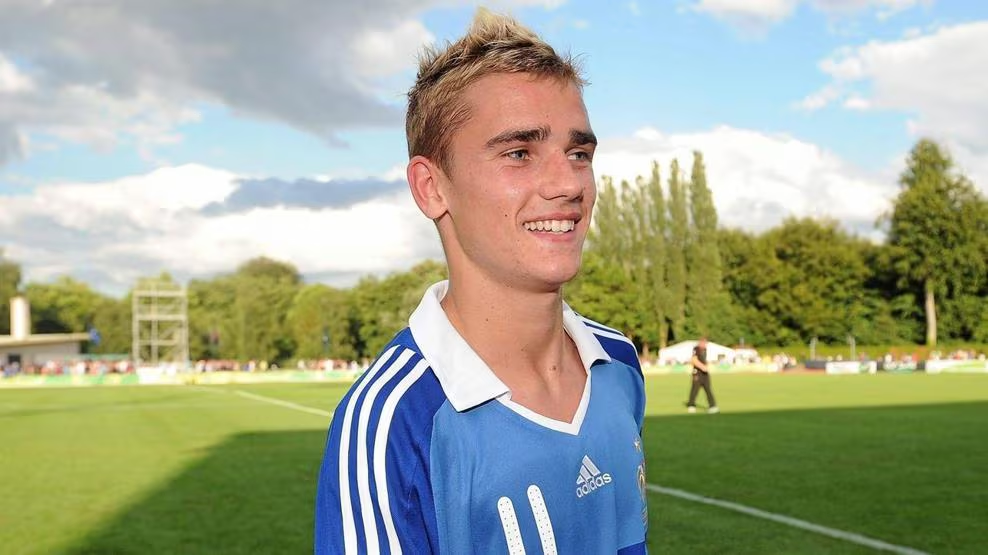
The following year, Griezmann made his La Liga debut in August of 2010, after signing his first professional contract for five years, lasting until 2015. At that time, he drew a lot of interest from some clubs in Ligue 1 but decided to stay in Spain to play professional, top flight football. However, it took him awhile to get going with goal contributions but he finally did after a few games, notching an assist after the September international break. It would take another month to score his first La Liga goal but over the season he recorded 11 goal contributions (six goals and five assists). He would then spend three additional seasons with Real Sociedad, helping them climb up the ranks of La Liga while also helping them qualify for the Champions League. In his time at Real Sociedad he would amass 201 games played and 52 goals with 16 assists.

After his great success in La Liga, Atlético Madrid would reach an agreement with Real Sociedad for Antoine Griezmann on a fee just short of his €30 million buy-out clause. Griezmann would sign a six-year contract with the Madrid club. He would start off a bit slow with his new club, getting more sub appearances than starts but he would eventually pick up steam in his first season, racking up 25 goals and 2 assists in his first year with Atlético Madrid. The following season would display his further rise in talent, scoring 32 goals and providing 6 assists in 54 games. After two spectacular seasons, he earned himself a contract extension through 2021. In that same season, he was voted 3rd in the Ballon d’or behind Cristano Ronaldo and Lionel Messi.

He would continue to have great seasons at Atlético Madrid but the team would fall short of a few different cups while he was there. Champions League and Europa League was allusive for the red and white. Since his form didn’t drop at all, Barcelona approached the young star, creating months of speculation. Griezmann dispelled the rumors by signing an additional year extension and telling the fans that Madrid was his home. He played a stellar season in 2018-2019 continuing to rack up serious numbers until finally Barcelona paid his €120 million release clause. There was some drama about the fee being paid but the player was presented to the team anyway and Griezmann was now a part of the Barcelona squad. In his first stint with Atlético Madrid, he racked up 133 goals in 257 matches.

In Barcelona, the Frenchman would do decently but never really found his footing with the outfit. He was relegated to the bench at times and would be put in some odd situations with the club. Even with all that, he was able to play 102 games for Barcelona and scored 35 goals with 17 assists. But it wasn’t enough to be a permanent fixture in the squad.

He was loaned back to Atletico Madrid in August of 2021 for a year that was soon extended to two years. Finally after all that, he was bought back to Atlético permanently and has played there ever since. In his second stint, he’s added to his totals playing in 234 games scoring 78 goals and 47 assists. He also became the all time goal scorer for Atletico Madrid with 211 goals and second all time in assists with 62. With a few games left, he has a chance to add to his stats before he joins Orlando City and bring a trophy to his long time club.
International Career
Alongside an illustrious club career, Griezmann had a stellar international career as well that is worth noting. He was first noticed by the French federation in 2010, when he broke on the scene with Real Sociedad. He was named to the U-19 French team and made his impact felt right away. He scored the game winner in his second match against the Ukraine. Due to that stellar play, he was named to the UEFA European U-19 Championship where he went on to score two goals and get an assist. He was also named in the “Team of the Tournament”.

In 2014, he received his first senior team call-up for France by coach Didier Deschamps. Due to his quality play, he earned himself a place on the French 2014 World Cup squad. He went on to play in three World Cups and multiple UEFA competitions. He would eventually retire from the national team at the end of 2024. In his time with France, he would make 162 appearances at all age levels for France and score 51 goals with 38 assists for his nation in that time.

Skill Set/Measurables/Advanced Stats
So now that we’ve gone over Griezmann’s lengthy background, let’s talk about some of his stats and his play so we can understand his on-the-field impact.
Positionally, he mostly plays as a second striker or as a centre-forward. Earlier in his career he would also play left wing but it’s been some time since he’s done that regularly. Depending on the system, you could see Griezmann shift between multiple positions. He has the technical ability, burst of speed to get past defenders, a quality finishing ability, and a great pass. Here is the latest highlight package to get you excited for the stats we’re about to breakdown.
Stats
For this one, I will be using Sofascore, Wyscout, and Fotmob to provide stats on Griezmann. Since he plays in one of the big five leagues, it’s very easy to get a large number of stats to show off. As always, I’ll start general and then drill down as we go.
General
To get it going, let’s look at a general view of what Griezmann has to offer. This chart is from this year even if he’s just above 1000 minutes. Last seasons chart doesn’t look much different. All the stats will be ranked against forwards in La Liga.

Shooting
We’re going to lead off this player profile with shooting seeing as Griezmann is a center forward/second striker. We’ll start with the most basic stat first-Goals. Griezmann ranks in the 77th percentile for goals scored. Moving to shots, his “Shot Total” ranks in the 84th percentile with his “Shots on Target %” ranking in the 84th percentile. This forward shoots and that’s exactly what you want him to do. A few more shooting stats, he ranks in the 90th percentile in “Goals per Shot” and the 87th percentile in “Goals per Shot on Target”. These just continue to solidify that when he shoots, he’s putting it on frame and it’s likely to go in. For the expected goal stats, the positivity rolls on as he ranks in the 85th percentile in “Expected Goals” and in the 91st percentile in “Non-penalty Expected Goals”.

Passing
After shooting, let’s move to passing as he has some interesting distribution stats that fans should enjoy. We’ll start with the basic stats of “Passes Completed” and “Passing Completion %”. For “Passes Completed-total number”, he ranks in the 100th percentile and ranks in the 94th percentile in “Passing Completion %” amongst all forwards in La Liga. These stats are very high and displays the quality that he has when passing the ball, even as a forward. Now if we dive a little deeper, we get a better picture of what Griezmann can provide.
When it comes to “Long Ball Passing Completion %” he ranks in the 80th percentile and for “Progressive Passes” he ranks in the 74th percentile. He really knows how to push the ball up the field with his passing ability and doing it in a long ball fashion. “Passes to Final Third” ranks in the 98th percentile and “Chances Created” ranks in the 92nd percentile. These two stats go hand-in-hand as it shows that those final ball passes into the final third really turn into a chance. Finally, “Assists” is the lowest stat in this category with Griezmann ranking in the 67th percentile. This is still above average for a forward so not too bad and he makes up for it with his “Switches”, that ranks in the 82nd percentile.
Possession
For possession, we’ll look at the most standard stat in “Touches”, where Griezmann ranks in the 97th percentile. Unfortunately, for the other touch stats we see that “Touches in the Attacking Penalty Area” he ranks in the 53rd percentile, just above the average. You’d want that number to be a bit higher but the number isn’t the most concerning. He seems to do his on-the-ball work a bit further out. For “Successful Take-ons” and “Successful Take-on %”, Griezmann ranks in the 23rd and 19th percentile respectively. His game doesn’t tend to lend itself to him taking on defenders at this point in his career. He also tends to use his passing to get around players. Now moving to carries that lead to an action, Antoine displays some quality numbers. “Carries Leading to a Shot” he ranks in the 85th percentile and “Carries Leading to an Assist” is in the 84th percent. When Griezmann carries, good things happen and we’ll see some additional carry stats in just a moment.
 As we look more into carries, the pure “carries” number is elite for Griezmann, as he sits in the 82nd percentile with his “Total Carrying Distance” ranking in the 62nd percentile. The total carrying distance seems to be an outlier but we’ll evaluate after the other carry stats. For “Progressive Carries” and “Progressive Carrying Distance”, he ranks in the 91st percentile in both. He really knows how to progress the ball and can carry the ball a good distance when he does. His “Carries into Penalty Area” rates out in the 88th percentile so he’s even carrying the ball into the opponents area to create more. Finally, the icing on the cake for his possession stats, Griezmann ranks in the 94th percentile in the “Dispossessed” category. With such a high score, you imagine Griezmann doesn’t have the ball taken away from him at all.

Defense
Let’s talk a bit about his defensive numbers. He does have some stats that stick out, especially for a forward. We’ll start with “Total Tackles” as that is the most basic stat. For “Tackles” he ranked in the 78th percentile, pretty solid for a forward. Now when we move to defensive duels, his numbers remain at a good level. When looking at total “Defensive Ground Duels Won” he ranks in the 83rd percentile with his “Defensive Ground Duel %” ranking out in the 62nd percentile. That’s an above average rate for a percentage and an elite level for number of duels won. It displays that when he’s in the position to defend, he can win the duel to get the ball back and move up field. Last in this category are his “Recoveries” where he ranks in the 90th percentile, an extraordinary number for a forward.

Now if we look to the second set of defensive stats we’ll look at interceptions, blocks, and tackles + interceptions. For “Interceptions” he ranked in the 73rd percentile, “Blocks” ranked in the 58th percentile, and “Tackles + Interceptions” ranking in the 76th percentile. Both the interceptions and tackles + interceptions rankings are above average, almost at the elite level. Again, you have to appreciate the effort on the defensive side of the ball. Blocks are just above average for Griezmann but you can rely on other players to block, when needed. “Clearances” and “Aerials Won %” are both below average, with “Clearances” ranking in the 47th percentile and “Aerials Won Percentage” ranking in the 40th percentile. Due to his size, the aerials shouldn’t surprise you. Clearances are also something you don’t expect much out of your forwards.

Discipline/Misc.
Last category is discipline, with only a handful of stats. We’ll start with cards and both are pretty easy to talk about. He ranks in the 100th percentile in both red and yellow cards. He doesn’t get carded so that’s good for the team. For “Fouls Committed” and “Fouls Drawn” he’s well below average. On “Fouls Committed” he ranks in the 3rd percentile and “Fouls Drawn” in the 16th percentile. He’s not going to draw many fouls and will commit a fair number when defending in transition.

Comparisons to Nani and two European Stars
This comparison is going to be two-fold. The first comparison will be between Griezmann and Luis Nani, to provide a club comparison. The second level of comparison will be between Griezmann, Thomas Müller, and Emil Forsberg to compare stars who came to MLS from Europe, each in their final season before coming to MLS. This should help give us a good idea of how his game could translate. Griezmann will be blue, Nani will be green, Forsberg will be red, and Müller will be gold. I will be using Wyscout and Sofascores data for this comparison.
Shooting Comp.
To start off we’re going to look at shooting, since all these players are attacking pieces. The charts won’t cover total goals but if we look at those numbers we would see that Nani had the most goals with seven, followed by Griezmann with six, than Forsberg with two, and Müller had one. Now if we look at “Shots”, everyone is a bit close. Müller leads the way ranking in the 85th percentile, closely followed by Griezmann in the 70th percentile, and Nani in the 64th percentile. Forsberg comes in a distant last, ranking in the 20th percentile. We’ll then go to “Non-Penalty Expected Goals” (or npxG). Müller leads the way, ranking in the 85th percentile, an elite level. Just behind him is Griezmann in the 78th percentile and Nani in the 62nd percentile. Forsberg is much lower in the 4oth percentile. “Non Penalty Goals” speak a slightly different story, with Nani leading the way by a ton coming in at the 98th percentile. Griezmann comes in at the 86th percentile and Forsberg in the 73rd percentile. Müller comes in just below average in the 47th percentile.
To dig a bit deeper into the advanced stats, “Non-Penalty Expected Goals per Shot”, Forsberg rates out at the elite level sitting at the 83rd percentile. There is a bit of a gap between the other three with Müller at the 62nd percentile, Nani at the 54th, and Griezmann at the 50th percentile.
The next stat is “Goals/Shot on Target %” (a shot on target that leads to a goal %) with Forsberg and Nani leading the way by a large amount, Forsberg in the 97th percentile and Nani in the 96th percentile. Griezmann is above average for this stat, at the 59th percentile, with Müller well below average in the 27th percentile. Finally, the last category we have is “Touches in the Penalty Box” which has a wide spread amongst the players. Müller ranks in the 98th percentile, followed by Griezmann in the 70th percentile, Nani in the 40th percentile, and Forsberg in the 17th percentile. The stat doesn’t necessarily point to anything in particular but obviously the closer you get to the net, the higher the chance you may have to score/assist.
Passing Comp.
Let’s now move to passing stats, as there are some interesting comparisons in those stats. We’ll start with “Short & Medium Passing %”, where all the players have an elite number expect for Müller. Griezmann leads the group in the 98th percentile followed by Forsberg in the 90th percentile and Nani in the 88th percentile. Müller ranks in the 25th percentile. When we look at “Long Pass %”, the story is rather similar with Griezmann having the best score in the 98th percentile, Nani in the 94th percentile, Forsberg in the 83rd percentile, and Müller in the 12th percentile. Anyone who has seen Griezmann’s game knows he can pass and these numbers just prove that, with Nani and Forsberg displaying the same class.
Next, we’ll turn our attention to Smart Passes or “a creative and penetrative pass that attempts to break the opposition’s defensive lines to gain a significant advantage in attack.”-according to Wyscout. We’ll start with pure “Smart Passes” with Griezmann and Müller, who lead the category, both ranking in the 89th percentile. Forsberg comes right behind in the 83rd percentile and Nani in the 77th percentile. If we look at “Smart Pass %”, Müller completely runs away with it, being in the 98th percentile, with Griezmann and Forsberg being just above average at the 59th percentile and 57th percentile. Nani is far below both in the 20th percentile. Finally, for this section, we look at “Cross Completion %” which is quite a mixed bag. Nani leads the group ranking in the 79th percentile, with Müller just behind in the 61st percentile. Both Griezmann and Forsberg are well below average with only a ranking in 35th percentile and 10th percentile respectively.
The next passing section we’ll focus on assists and all the numbers that are around it. Let’s start with pure “Assists” then dive deeper. Both Nani (94th percentile) and Müller (95th percentile) lead the pack with their stellar numbers. Griezmann (62nd percentile) and Forsberg (58th percentile) are still above average in this category but not at the elite level. All four really contribute when it comes to assists. If we look at “Expected Assists”, we see Müller at the top of the charts rating in the 100th percentile but Griezmann is right behind him in the 99th percentile. Nani rates out in the 84th percentile with Forsberg down in the 15th percentile.
Now we will examine Shot Assists or “an assist that leads to a shot-does not have to be a goal”. These are all similar numbers to Expected Assists, with all players just a tick lower. “Expected Assist per Shot Assist”, the numbers change a bit. Müller leads the group again, scoring in the 88th percentile with the other three still above average, but a fair amount below at 68th percentile for Griezmann, 58th percentile for Nani, and 40th percentile for Forsberg.
Lastly, we’ll cover “Second Assists” a stat that MLS counts towards their assist numbers, so it should tell quite a story. Griezmann rates out in the 100th percentile for second assists and clears the rest of his colleagues by a fair amount. Nani comes in next in the 61st percentile followed by Forsberg in the 45th percentile. Müller brings up the back of the group well below average in the 21st percentile. This tells us that not only can Griezmann find the primary assist and perform the numbers that the metrics tell us he should, but it also tells us that he can pass the ball to the player who will find that final ball to at least get a shot off. That combination play is what’s made Griezmann so lethal in his career.
Possession Comp.
There are a few possession stats we can talk about amongst the four players that should give us some good insight as to how these players progress and dribble the ball. We’ll start with Progressive Passes first or “A forward pass that attempts to advance a team significantly closer to the opponent’s goal.” since we just talked about passing. Griezmann and Nani are elite in this category, with Griezmann scoring in the 98th percentile and Nani in the 94th. Müller and Forsberg are well below average sitting in the 36th and 27th percentiles each. “Progressive Carries” are a bit closer, with Griezmann still leading the way in the 76th percentile, Nani right behind in the 68th percentile, and Müller just above average in the 54th percentile. Forsberg gets even lower in this stat, rating in the 10th percentile. These stats tell us that Griezmann finds a way to move the ball forward whether it’s a pass or a carry.
The next stat is an interesting one and a stat people may not think much about. “Acceleration with the Ball” can display how quickly a player can fast break or assist in a 1v1 opportunity. Griezmann is above average in this category, ranking in the 68th percentile. Nani comes in right behind, slightly above average in the 53rd percentile with Müller and Forsberg well below average at the 26th percentile and 8th percentile. With the combination of all those stats, we finally move to “Dribble Success” and these results shouldn’t surprise you. Griezmann ranks in the 86th percentile with Nani slightly above him in the 88th percentile. Forsberg and Müller are very much down the list, with their numbers not worth mentioning at their low rate. It’s not an insult to these players, it’s just not part of their game. 
Defense Comp.
To save the best for last, let’s talk about some defense for this attacking players. I’m only using three categories on this one since it was hard to find consistent defensive stats for all four players. We’ll start with “Tackles + Interceptions” first since it’s the most common stat. Forsberg takes the top spot, ranking in the 87th percentile with Griezmann right behind him in the 82nd percentile. Nani is still above average but a bit behind the first two, ranking in the 66th percentile, with Müller well behind in the 22nd percentile.
For “Aerial Win %”, Nani leads his peers with a staggering 88th percentile rank but Griezmann is right behind, ranking in the 78th percentile. Müller is slightly below average with a 42nd percentile ranking and Forsberg is at a lowly rank, in 13th percentile. Lastly, “Defensive Actions” show a big gap between the four attackers, with Griezmann far above the rest ranking in the 78th percentile. Forsberg and Nani are next with a 30th and 26th percentile ranking while Müller is far below in the 6th percentile. Griezmann plays his role on defense and seems to understand how it can affect the team based on how much effort he puts into defending. This bodes well for an Orlando team that, at times, asks all of their players to defend.

Comparison Conclusions
So now that we’ve broken down each category for comparison, what are the main takeaways? To start general, I think a comparison to Nani was warranted. When you look at shooting, passing, and possession they line up almost identically, with Griezmann getting the slight edge in a lot of those categories. Take it one step further and you’ll see that Griezmann has better final ball stats than Nani, adding something to this team that we haven’t possessed, at that level, for some time. Defense also has a similar story, with both players being almost identical in performance but Griezmann has a lot more defensive actions.
If we look at Nani’s stats over the three years he was in Orlando, he had 28 goals with 16 assists. He averaged about 1800 minutes a year with those numbers, so not a ton of minutes in the grand scheme. Griezmann over the last 3 years has cleared 2500 minutes, which if the Frenchman can keep up, would indicate that he should contribute more when it comes to goal contribution stats compared to what Nani was able to do. The one thing to keep in mind is that Nani did come over at age 32 compared to Griezmann’s age 35, which could play a role. Age isn’t everything these days but it’s something we should keep in mind.
If we look at the two other superstars who came to MLS from Europe in Emil Forsberg and Thomas Müller, the argument gets stronger for Griezmann. In a lot of the stats around defense, passing, and possession the argument is the strongest but those items have always been the bigger focus for Griezmann. You could make the argument that passing was also key for Forsberg and Müller but the way they were used, slightly differed. Shooting is where we can see a bit of a step back from Griezmann compared to his colleagues but only in categories like quality of shot (how on target is the shot or how high is the expected goal per shot) and touches in the penalty area. This is another argument of how Griezmann was deployed in the lineup and how many minutes for the player in league vs minutes in competition play.
But let’s take it a step further and look at the rankings that both Forsberg and Müller had for their first seasons in MLS. For Müller, there is the caveat the he only had half a season and came into a team that was pretty high quality. But we’ll start with Forsberg first:


Now if we look at the two charts we can see some interesting changes between the Bundesliga and MLS. We’ll start with the shooting category first. Forsberg had less Non-Penalty Goals, Goals/Shot on Target, and Non-Penalty Expected Goals per Shot. However, his shots went way up. His assist numbers did rise steadily as well. Shot Assists, Expected Assists, and Expected Assists per Shot Assist all went up steadily, with the Smart passes and Second Assists barely going down, within the margin of error. His Long Pass % went up a tick but everything else did see a decrease. Progressive Passses, Progressive Carries, Acceleration with Ball, and Dribble Success % all went up by at least a level compared to his final season with Leipzig. This also helps explain that his role with Red Bull New York changed compared to what he was doing in Germany.
Now for Müller, here are the two charts for comparison:


We’ll start with shooting first again, as for all the players that’s an important stat. Non-Penalty Goals, Goals/Shot on Target Percentage, and Shots are all much higher with Vancouver than with his time with Bayern. Non Penalty Expected Goals, Non-Penalty Expected Goals per Shot, And Touches in Penalty Box are all marginally lower with Vancouver but not enough to affect the overall performance of Müller.
If we turn our attention to passing stats, things get a bit worse in Vancouver but again, within the margin of error. Shot Assists, Expected Assists, Expected Assisted per Shot Assist, and Assists all decrease. He is slightly up for Smart Passes but only marginally. Cross Completion % was up a bit in Vancouver as was his Short & Medium Passing %. We can then look at the possession stats which have taken a much larger jump up. He’s improved vastly in Progressive Passes, Progressive Carries, and Dribble Success %. He did slightly go up in Acceleration with Ball and in his Defensive Actions. So again, we see some attacking stats dip a bit but within a small margin but we see possession stats jump up.
So How Does Griezmann Fit into Orlando City?
First, he brings leadership and class that you don’t get with every player. This club has lacked that level of leadership since Nani was here over a half decade ago. He’s not only going to lead with his words, but he’s going to lead by his play on the field and his drive to win. In the bit that we’ve already seen from him, you can see all that and then some. The club has done a pretty good job showing that off over the last few days. You don’t want to over look the leadership he’ll bring and the fact that his name will help with jersey sales as well as ticket sales (at the end of the day it will be a factor).
The other item we have to talk about, before we get to tactics, is the influence he can have when it comes to the club finding its next manager. The club is currently rolling with Martin Perelman but he is very much an interim manager. This isn’t to say he couldn’t win the job, but with the way it’s started, that seems highly unlikely. Now, I’m not saying Griezmann is going to make the manger decision by walking in and saying “I want this guy”.
But what I think will happen is two things: first, he’ll persuade managers to come to Orlando to coach, sort of unlock managers who may not have considered the club. Second, he’ll have a name or two to pitch to the front office and even be a part of meetings when they try to close a manager. These are things to remember as the search goes on. We also can’t forget that he can do the same with players. We’ve seen the team down south use that to their advantage. I’m not putting Griezmann on that same level but for a guy who has spent his entire career in Europe and more than a decade on the national team, you have to imagine his has some guys he could call up to come play for this side.
Tactics and Graphics
Let’s move to the tactics sides because I think this is a question fans have that I can, hopefully, shed light on. I’ll start by providing a heat map and a passing/dribbling map, while explaining the significance of both. This will give us some insight as to how he’s been playing and how he’s been deployed. I’m going to look at this years and last seasons maps to help us get a better perspective. The biggest reason is that his minutes have been almost half this season compared to last season. I will provide two charts below to help give some context to my analysis that explains thirds of the field and the lanes on the field:


Before we get deep into the analysis, let’s look at a quote from Ricardo Moreira in his interview with SiriusXM FC featuring Max Bretos and Dax McCarty. He asked where he sees Griezmann playing for Orlando City.
“We’re bringing in Griezmann to get goals and assists. He’s going to contribute up top. We’re imagining him as a false 9, we’re imagining him…as the media punta, he’s the second striker.”-Ricardo Moreira, Orlando City General Manager and Sporting Director
We’ll start with the heat map first:


The biggest thing we can take away from the heat maps is the Griezmann ends up in the half spaces on the left and right side of the field, mostly ending up on the right. There are some times where he ends up in the wide areas, more specifically on the left wide area. You can also see that Griezmann really takes up a lot of space in the middle third, with many of it being at the higher end or lower end of the final third. He really commands much of the center channel in the middle third and gets wider when he comes into the final third.
Currently, Martin Ojeda occupies much of the left half spaces and left wide area, so there could be a bit of crossover that could cause issues with two players in the same space. Based on what Griezmann has shown us, this may be a simple suggestion of asking him to drop in the right half space as opposed to the left half space, unless Ojeda gets wide and stays wide in the left wide area. Now if he drops into the right half space or right wide area (which would happen less often) he would have the potential of running into the spaces commonly occupied by Marco Pašalić. Pašalić really hugs the right wide area until he gets to the 18 where he gets in the right half space. This shouldn’t be as much of an issue since Pašalić cuts in when he gets the ball, and when he doesn’t, he stays in the right wide area. So Griezmann will really want to stick to the half spaces and center area higher in the middle third and the half spaces and center area in the final third.
To prove that practice, let’s take a look at a few charts to help. The first one will be his attacking actions:

As you can see, many of his progressive actions lean towards the right but are very much in the center of the field and the half spaces at the higher end of the middle third and the lower part of the final third. The carries very often lean left with the passes going in both directions. His position on the field lends himself to being either a “10” or a “false 9”. We’ll look at one more chart to help understand his game a bit more, this one focused on all his events on the field:

The dots on the far left chart are where attacking events occurred (shots, dribbles, shot assists, and aerial duels). There are a lot more events on the right side of the pitch in the center area, around the 18. The shaded in box is where most of the actions take place, which really encompasses the right side of the 18 towards the center of the 18. For receiving passes, he really occupies that right half space, bordering on the middle third and final third. That receiving area should really work out for the team since Pašalić should stay wide in those moments or even be further in the box.
Formations
Let’s talk about some formations to round out our conversation on where Griezmann can play. I have a few different ideas when it comes to how Orlando City could deploy Griezmann. The players used in this experiment aren’t necessarily my top choice, just who has been available as of late and who has been in form.
4-2-3-1

So in a 4-2-3-1, Griezmann would occupy the striker spot but in this case would play a “false 9” role dropping into the midfield. Ojeda from the “10” spot would move up and to the left, with Angulo flying up the left wing to keep the width. Pašalić would move up and centrally to play as a second striker on the right side of the box. Atuesta would play a box-to-box role supporting Griezmann, while Braian Ojeda would cover the back line defensively. Dorsey would head up the right side providing width on the right and occupying the space vacated by Pašalić. Marin would stay back and form a back three and if the team wanted, they could have him move up and cover the central space next to B. Ojeda. This is what the formation would look like in practice:

It very much looks like a 3-1-3-3, allowing all the attacking players to get involved (front four) with Atuesta as some cover at the top of the box and Dorsey equally on the wing to provide an outlet for the offense. Dorsey could also underlap Pašalić at times to create a central overload and allow Dorsey to shoot.
4-4-2

Orlando City could look to find a way to get M. Ojeda and Griezmann higher up the field to start, while keeping the two players near each other in the hopes of some connective interplay. Griezmann would still drop a bit as a “false 9” but stay a bit higher up the field compared to before. M. Ojeda would stay up and to the left. Angulo would keep the width on the left side, Pašalić would move up and cut in left, Atuesta would move up to play a box-to-box role, and B. Ojeda would shift over to cover ground. Dorsey would push forward to keep the width on the right side and Marin would tuck in to form a back three.

Similar looking attack structure to the 4-2-3-1 except you get an extra body in the attack. Currently, I have Pašalić in that second striker role but it could very easily be Griezmann, with Pašalić coming shorter in the attacking mid role. Atuesta is the cover to keep the attack going while B. Ojeda covers ground and is the first line of defense.
3-4-3

This formation is my first pure three center back set and opens the door to talk about that option for this team. In this formation, we see Griezmann drop as a “false 9” to occupy the space a “10” would occupy. You see M. Ojeda shift out to the left wing and allow him to cut in centrally, Pašalić will cut in from the right centrally, which in theory, gives you two guys in the box. Angulo takes the space vacated by M. Ojeda with Dorsey taking the space vacated by Pašalić. B. Ojeda and Atuesta sit in the middle of the park, with the opportunity for Atuesta to push up field to offer support.

This formation makes the formation look like a 3-1-1-3-2 in attack, with at least 5 players in the attack with a trailing run or recycler in Atuesta. It allows B. Ojeda to patrol the field and fit in wherever he’s needed. You can also get quality interchanges between Angulo and M. Ojeda, Pašalić and Dorsey, or either forward and Griezman.
3-5-2

The last formation I have to share today is a 3-5-2 which puts the team in a great formation for 3 strong defenders in the back (the best 3 when everyone is healthy) and allows you to really attack. This time we put M. Ojeda and Griezmann next to each other, to either stay up top and play off each other or you let Griezmann drop into the “false 9” role and let him facilitate. Pašalić goes forward and towards the box, Angulo stays wide but pushes up the field, Atuesta presses up and joins Griezmann as a second attacking midfielder or becomes the solo one, if Griezmann stays up. For the three midfielders, B. Ojeda goes centrally and plays a box-to-box role and recycler while Atuesta goes up, and Luis Otávio goes back to help cover ground and guard the back line. He could also play at a similar position level with B. Ojeda and let B. Ojeda go forward and back.

When getting forward, we see a 3-1-1-2-3. M. Ojeda and Pašalić stay forward and central with Angulo as your wide option. Atuesta and Griezmann are your attacking midfielders working off of each other and the forwards in front. B. Ojeda is your box-to-box runner and covers where he needs to be. Otávio becomes your bulldog in the middle of the park to be the first line of defense. If you want to go more attacking, you could pull Atuesta, put Angulo centrally and put Tiago at LW to let him crash the box. Angulo then gets to play off of Griezmann and you get the speed to get back.
Final Thoughts
Regardless of how you think about this team currently and their start to the season, adding Antoine Griezmann is a big move on and off the field. Griezmann will change the way this team operates, will lead the boys in the locker room, and still has the class to affect the game on the field. He also fits the mentality of what this team is looking for in a star. He’s easygoing off the field, but a fighter on it, and he’s going to drag this team to a fighting mentality. He’s not going to necessarily bring the Latin chippiness that this team has possessed in the past but the fight is just as important. I, like many, can’t wait to see him on the pitch and see what effect he can have on this season. We may be too far gone in the season to make waves when he arrives in July but what we build in the back half will be important for the other competitions we’re in as well as the short season we have at the beginning of next year. If you aren’t excited already, you should be. This summer is going to be fun, with a French flair.



Leave a Reply