
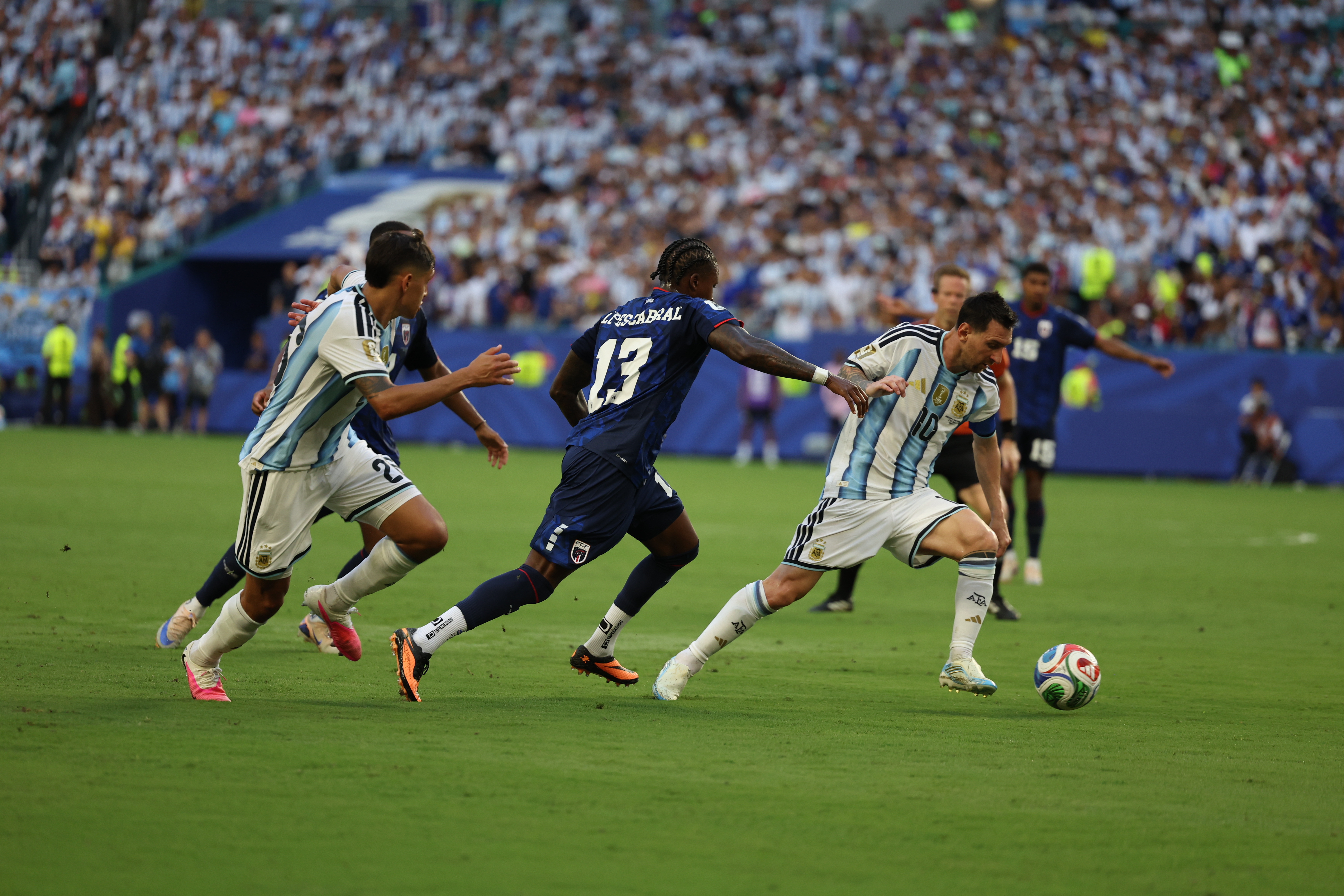
If you were looking for a calm, routine walk-in-the-park for the reigning world champions, you were at the wrong stadium on Friday night. Miami Stadium was absolute bedlam. It felt like the entire population of Argentina had descended upon South Florida; the stands were a swaying, neon-blue sea of sound, shaking the very foundations of the arena as thousands of supporters belted out their anthems. In the middle of all this noise, a small group of less than 1,000 Cape Verdean fans stood their ground, a bright spot of color in the sea of Albiceleste fans.
The opening stages were a chess match played at a sprinter’s pace. Argentina came out swinging, but Cape Verde refused to flinch, maintaining a disciplined, compact shape that made the pitch feel impossibly small. They weren’t just parking the bus; they were hunting for pockets of space. It was a cagey, tactical stalemate for the first half-hour. In the 17th minute, things got chippy when Cabral caught Messi with a heavy challenge—offering a quick, respectful apology for the roughness that told you everything: the match wasn’t going to be a friendly exhibition.
Then, the inevitability of greatness took over. In the 29th minute, Lisandro Martínez launched a sumptuous ball over the top, and Messi—who had been a ghost until that moment—materialized behind the defense. He caught the ball in mid-stride and, with a flick of his boot, lifted it past Vozinha into the near corner. It felt like the preamble to an Argentina blowout, and we all settled in, expecting the game to open up. But the Blue Sharks—playing with the kind of fearless grit usually reserved for movies—held the line.
The second half was where the “impossible” became “plausible.” Cape Verde started probing, their confidence growing with every clearance. When Deroy Duarte squeezed his equalizer into the far corner in the 59th minute, the air left Miami Stadium. Argentina looked, for the first time in this tournament, genuinely rattled. The physicality of the game ramped up significantly; tackles flew in, jerseys got tugged, and the match became a gritty, ugly, beautiful slog. Cape Verde wasn’t just defending; they were launching counterattacks that had the Argentina backline scrambling.
Extra time was pure, unadulterated madness. Lisandro Martínez looked to have settled the nerves early on with a strike that screamed “relief,” but Sidny Lopes Cabral responded just minutes later with a long-range thunderbolt that will likely be replayed for decades. It was a moment of pure genius that made the entire stadium go silent before erupting. Finally, the heartbreak for Cape Verde arrived in the 111th minute—a cruel, deflected own goal off Diney that ultimately decided the 3–2 result.
Argentina won because they possess that championship “grim determination” to find a way to win even when their fluidity abandons them. They have the depth to throw bodies into the box and the individual magic to make something happen.
Cape Verde lost, but they didn’t leave as losers. They played a perfect game for 99% of the match, but against a side like Argentina, you only have to lapse for a moment or be on the wrong side of a deflection for it to be over. Eventually, the immense pressure and the physical toll of 120 minutes of high-intensity defense wore them down.
Here is the uncomfortable truth for La Albiceleste: If they play like that against France, Spain, or England, they might be boarding a flight home.
Cape Verde pushed them to the brink by matching their physicality and closing down space with terrifying efficiency. If an underdog with a fraction of the budget can force Argentina into 120 minutes of absolute chaos, what happens when they face a team that has that same level of tactical discipline and the world-class talent to punish them on the counter? This wasn’t just a “bad day at the office.” It was a massive warning sign. Argentina’s path to the trophy looks a lot steeper this morning than it did yesterday, and they’re going to need much more than just Messi’s brilliance if they want to survive the heavyweights waiting in the next round.
Español
Si esperabas un paseo por el parque para los campeones del mundo, te equivocaste de estadio este viernes. El ambiente en el Miami Stadium fue una auténtica locura. Parecía que toda la población argentina se había mudado al sur de Florida; las gradas eran un mar de ruido y color azul, haciendo vibrar los cimientos del estadio mientras miles de hinchas cantaban al unísono. En medio de ese rugido ensordecedor, un pequeño grupo de menos de 1,000 caboverdianos se mantuvo firme, una mancha desafiante en medio de la marea albiceleste.
El arranque fue un juego de ajedrez a toda velocidad. Argentina salió a comerse la cancha, pero Cabo Verde no se achicó, manteniendo un orden defensivo que hacía que la cancha se sintiera chiquitita. No se limitaron a encerrarse atrás; buscaron espacios para dar el zarpazo. Fue un comienzo trabado, donde Argentina no lograba que Messi entrara en ritmo, en gran parte por la disciplina táctica de los “Tiburones Azules”, quienes demostraron que sus partidos ante España y Uruguay no fueron casualidad. En el minuto 17, el juego se puso físico cuando Cabral le cometió una falta fuerte a Messi, disculpándose de inmediato, un gesto que dejó claro que esto no iba a ser un partido amistoso.
Luego, la genialidad tomó el mando. En el minuto 29, Lisandro Martínez metió un pase magistral y Messi —que había estado desaparecido hasta ese momento— apareció a espaldas de la defensa. Controló en carrera y, con un toque sutil, la mandó al fondo. Parecía el inicio de una goleada, pero Cabo Verde, con una garra digna de película, aguantó el chaparrón.
La segunda mitad fue donde lo imposible se volvió creíble. Cabo Verde empezó a crecerse, y cuando Deroy Duarte clavó el empate en el minuto 59, el aire se le escapó al estadio. Argentina se vio, por primera vez en el torneo, genuinamente nerviosa. El partido se volvió un choque de trenes: patadas, agarrones y un ida y vuelta agónico. Cabo Verde no solo defendía; cada contraataque ponía a temblar a la defensa argentina.
El tiempo extra fue locura pura. Lisandro Martínez parecía haber calmado las aguas con su gol, pero minutos después, Sidny Lopes Cabral soltó un bombazo de larga distancia que seguramente veremos en los resúmenes por años. Fue un golazo que dejó al estadio en silencio antes de explotar. Finalmente, el destino fue cruel con Cabo Verde: al minuto 111′, un autogol desviado de Diney terminó sentenciando el 3–2 definitivo.
Argentina ganó porque tiene esa “garra” de campeón, esa capacidad de sacar el resultado cuando el fútbol fluido se apaga. Tienen el banquillo y la magia individual para resolver un partido en un córner o una jugada aislada.
Cabo Verde perdió, pero salieron con la frente en alto. Jugaron el partido perfecto durante el 99% del tiempo, pero ante Argentina, un segundo de distracción o un rebote desafortunado es todo lo que hace falta para irte a casa. El desgaste físico de 120 minutos defendiendo con esa intensidad les pasó factura.
Aquí está la verdad incómoda para La Albiceleste: si juegan así contra Francia, España o Inglaterra, se suben al avión de regreso a casa mañana.
Cabo Verde los llevó al límite, igualando su intensidad y cerrando espacios con una eficiencia aterradora. Si un equipo con un presupuesto infinitamente menor pudo forzar a Argentina a vivir 120 minutos de caos, ¿qué pasará cuando enfrenten a potencias que tienen esa misma disciplina táctica, pero con el talento de élite para liquidarlos de contra? Esto no fue solo un “día malo en la oficina”; fue una advertencia. Hoy, el camino al título se ve mucho más empinado que ayer, y Argentina necesitará mucho más que la magia de Messi si quiere sobrevivir a los pesos pesados que se avecinan.



Leave a Reply